

How solar panels work, in plain words
Cells, panels, arrays, and the parts that turn their power into what a home uses.
Disclosure: We may earn a commission if you buy through links on this page. It does not change our guidance. Affiliate Disclosure
What a PV cell does
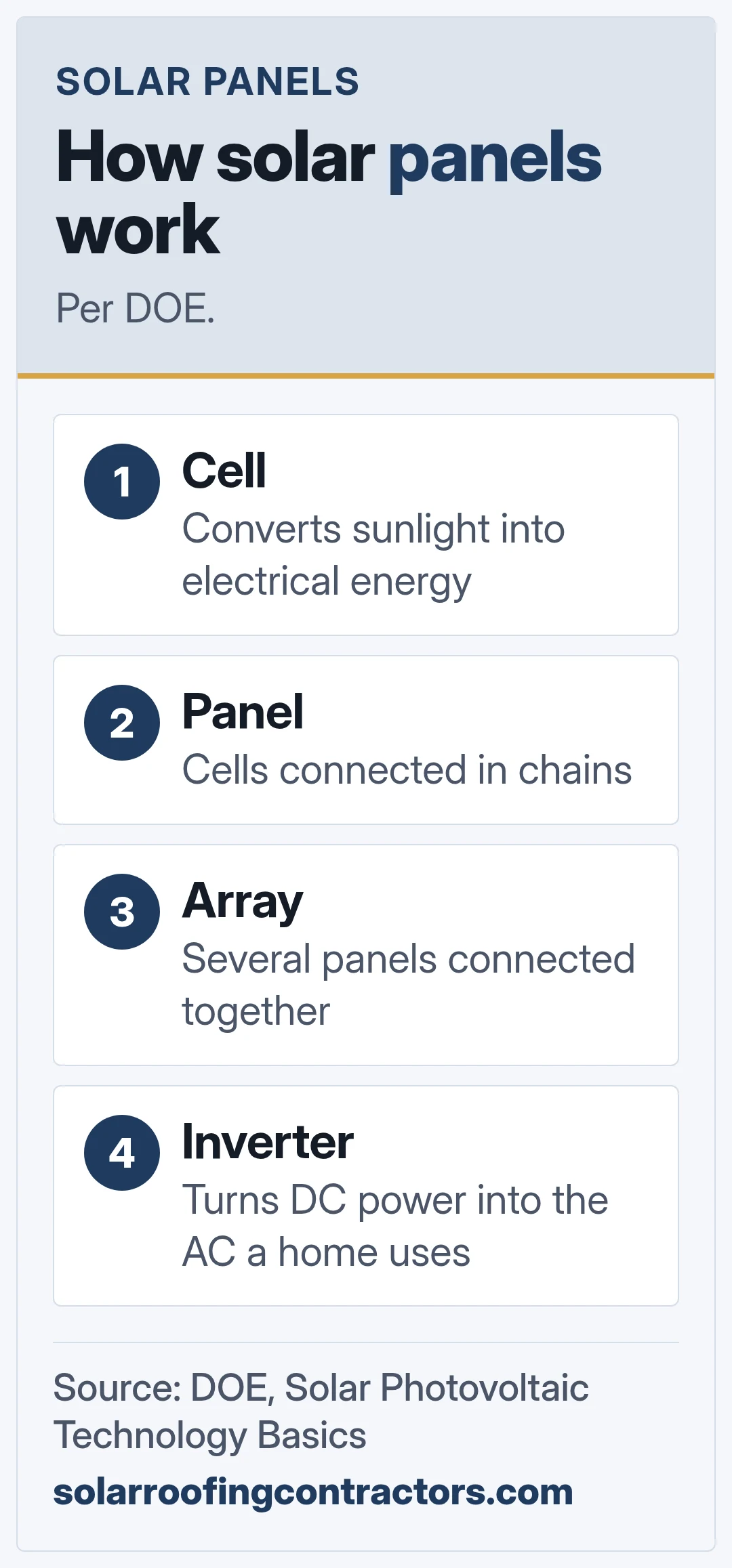
DOE says "Photovoltaic (PV) materials and devices convert sunlight into electrical energy." DOE says "A single PV device is known as a cell."
Cells, panels, and arrays
DOE says cells "are connected in chains to form larger units known as modules or panels," and that several modules "can be connected to form arrays."
The rest of the system
DOE says PV systems "also include mounting structures that point panels toward the sun, along with the components that take the direct-current (DC) electricity produced by modules and convert it to the alternating-current (AC) electricity used to power the appliances in your home."
What changes the power you get
The FTC says the power you get depends on "the size and strength of your system," "the average number of hours of direct, unshaded sunlight your roof gets annually," "the pitch (angle), age, and condition of your roof, and the direction it faces," and "environmental factors like snow, dust, or shade that may cover the system."
What we do not say
We do not give costs, savings, payback, or home value figures. We do not say how much power any system will make. Ask for it in writing in each bid.
This is general information, not tax, financial, legal, or engineering advice.
Sources: DOE, Solar Photovoltaic Technology Basics; FTC, Solar Power for Your Home.
FAQ
General information only. We are not a contractor, installer, lender, or tax adviser. We do not refer, match, vet, rate, or check contractors, and we do not collect your information. Before you hire anyone, verify their license or registration with your state (in Washington, use the Department of Labor & Industries' Verify tool), get written bids, and read every contract and financing document. For tax questions, see IRS.gov or ask a tax professional.



Next: solar shingles and tiles
Solar built into the roof.
