

The federal solar tax credit: what the law says now
The residential clean energy credit, section 25D, in the words of the law and the IRS.
Disclosure: We may earn a commission if you buy through links on this page. It does not change our guidance. Affiliate Disclosure
What the law says now
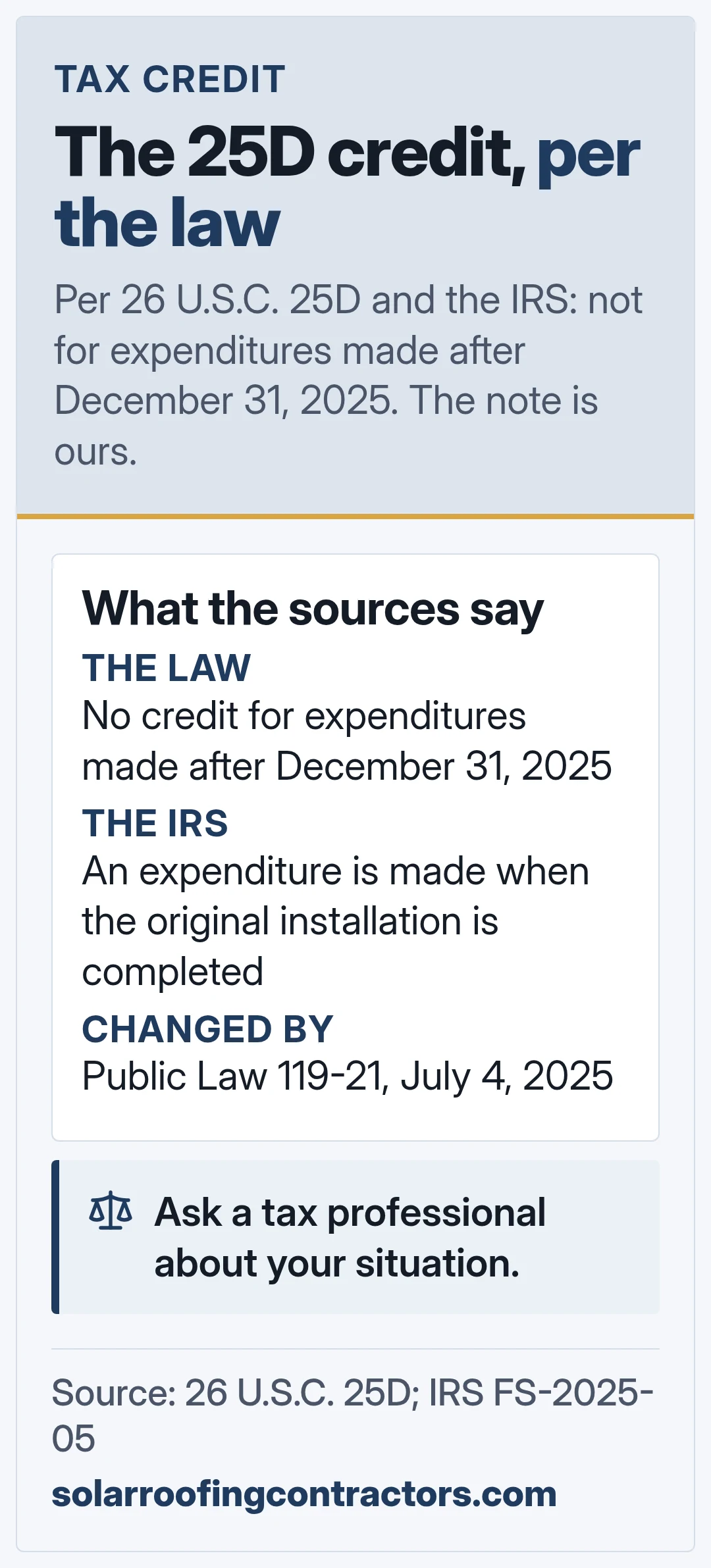
Under federal law as amended on July 4, 2025, the residential clean energy credit (Internal Revenue Code section 25D) does not apply to expenditures made after December 31, 2025. The IRS says an expenditure is treated as made when the original installation is completed. See IRS.gov for details, and ask a tax professional about your situation.
The statute
26 U.S.C. 25D(h) now reads: "The credit allowed under this section shall not apply with respect to any expenditures made after December 31, 2025." Public Law 119-21, section 70506, made that change on July 4, 2025.
The IRS on installation
The IRS says: "If installation is completed after December 31, 2025, the expenditure will be treated as made after December 31, 2025, which will prevent the taxpayer from claiming the section 25D credit."
The IRS on its FAQs
The IRS says its FAQs "may not address any particular taxpayer's specific facts and circumstances."
What we do not say
We do not say that you can claim this or any other credit, rebate, or incentive, and we do not cover state or utility programs. See IRS.gov, and ask a tax professional.
This is general information, not tax, financial, legal, or engineering advice.
Sources: 26 U.S.C. 25D (uscode.house.gov); Public Law 119-21, section 70506 (govinfo); IRS, FAQs for modification of sections 25C, 25D, 25E, 30C, 30D, 45L, 45W, and 179D under Public Law 119-21 (FS-2025-05).
FAQ
General information only. We are not a contractor, installer, lender, or tax adviser. We do not refer, match, vet, rate, or check contractors, and we do not collect your information. Before you hire anyone, verify their license or registration with your state (in Washington, use the Department of Labor & Industries' Verify tool), get written bids, and read every contract and financing document. For tax questions, see IRS.gov or ask a tax professional.



Next: warning signs
The FTC's warning signs.
